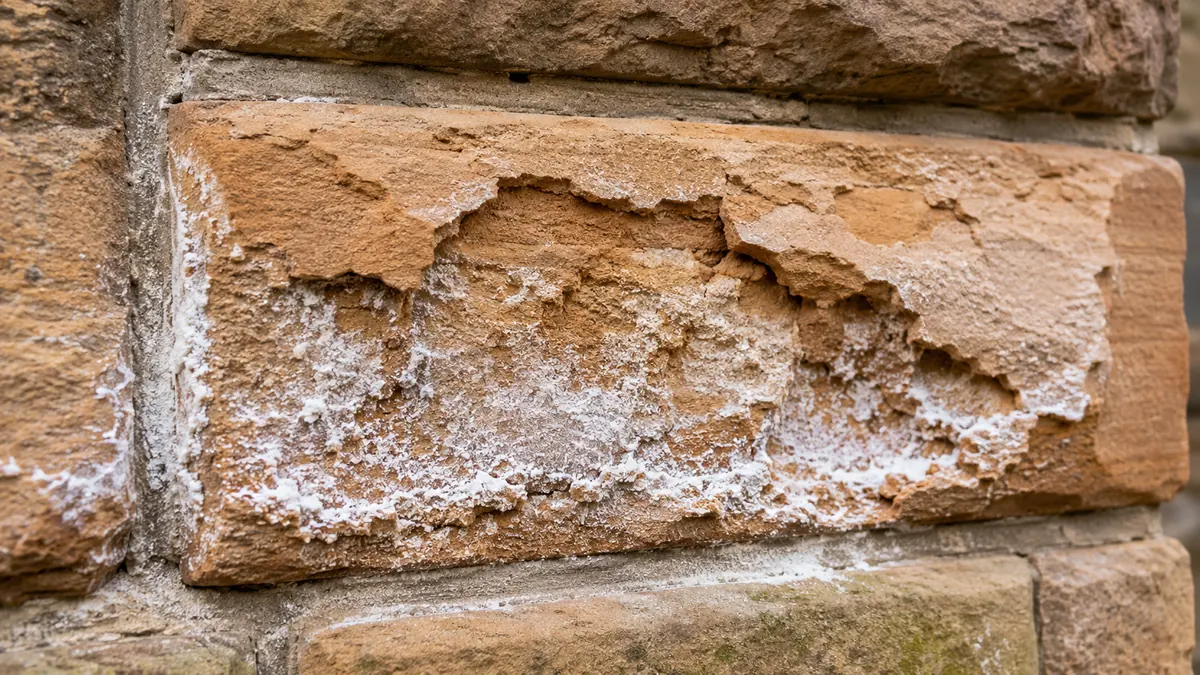
Decayed, spalling or crumbling sandstone? Specialist repair for Stirling's blonde stone buildings — from stone indents and replacement to breathable lime repairs that save the original fabric.
Repointing fixes the joints — but sometimes it is the stone itself that has failed. Across Stirling's tenements, villas and listed buildings, the local "blonde" sandstone quarried at Polmaise, Black Craig and Dunmore is soft and porous, and after a century or more of weather it can start to crumble, flake or lose its face entirely.
The Central Belt climate makes it worse: over 1,100 mm of rain a year and repeated winter frosts drive moisture into the stone. Where old cement repairs or trapped salts are involved, that moisture blows the surface off the stone from within — the decay you see as spalling, delamination and eroded detail. The good news is that most of it is repairable without replacing whole blocks, if it's caught in time.
The right method depends on how far the stone has decayed. We always keep as much original stone as possible.
Where one part of a block has decayed, we cut out just the damaged section and let in a matching new piece — keeping the maximum original fabric at lower cost than full replacement.
For a stone that has broken down structurally or lost its face entirely, we source and match a new sandstone of the same geology, bedded and pointed in lime.
Minor losses and eroded edges are rebuilt with a colour- and texture-matched lime mortar shaped to the original profile — the lightest-touch repair for superficial damage.
We address the cause, not just the symptom — removing trapped cement, restoring breathability and letting the wall shed the salts and moisture that drove the decay.
Not sure which applies? Read our full guide to sandstone repair methods, or just ask for an assessment.
Sandstone repair is one area where the wrong approach does lasting harm. Filling decay with hard cement, or replacing with a denser stone than the original, traps moisture and accelerates decay in the stone next door. Every repair we make is breathable and matched — softer than or equal to the parent stone — so the building keeps working the way it was built to.
Done properly, a sandstone repair is nearly invisible and lasts for generations. Done badly, it becomes next winter's problem. That difference comes down to diagnosis, matching and lime — which is exactly where our work to Scottish Lime Centre Trust standards comes in.
Based in Stirling, repairing sandstone across the wider Central Belt.
We repair before we replace — keeping as much of your historic stone as the condition allows.
Our work follows Scottish Lime Centre Trust best practice for conservation and listed buildings.
Every repair is backed by a 24-month guarantee, on top of lime's naturally long life.
New stone and mortar are matched in type, colour and texture to Stirling's blonde sandstone.
Get a free, no-obligation assessment from a specialist who works to Scottish Lime Centre Trust standards — right here in Stirling and the Central Belt.
100% no obligation & guaranteed not a waste of time