The short answer
There is no single "best" way to repair sandstone — there is only the right method for the specific problem in front of you. Failing joints call for repointing; a locally decayed block calls for a stone repair or indent; a stone that is structurally gone needs replacement; a wall that has lost its protective coat needs harling or render. The one rule that runs through all of them: whatever goes back on a historic wall must be breathable and no harder than the stone.
Diagnosis comes before method. The same crack or damp patch can have very different causes — so the correct repair is only clear once the wall has been properly assessed. Matching method to cause is what protects the stone and your budget.
Match the method to the problem
This is the quick orientation our clients see when we survey a building. Find the symptom, and the sensible method follows.
| The problem you can see | Sensible method | Why it's the right fix |
|---|---|---|
| Crumbling, missing or hard cement joints | Lime repointing | Restores a breathable, sacrificial joint so the wall sheds water and the stone stops eroding. |
| One block decayed or spalled, rest sound | Stone repair / indent | Replaces only the damaged part — keeps as much original stone as possible at lower cost than full replacement. |
| A stone badly broken down or structurally failed | Full stone replacement | A matched new stone restores strength and appearance where repair is no longer viable. |
| Lost or failed external render / harling | Lime harling or render | Re-establishes the breathable protective coat the wall was designed to have. |
| Small surface loss or eroded detail | Lime (plastic) repair | A colour-matched lime mortar rebuilds minor losses without replacing the whole stone. |
Lime repointing
Best for: failing, missing or cement-filled joints where the stone itself is still sound.
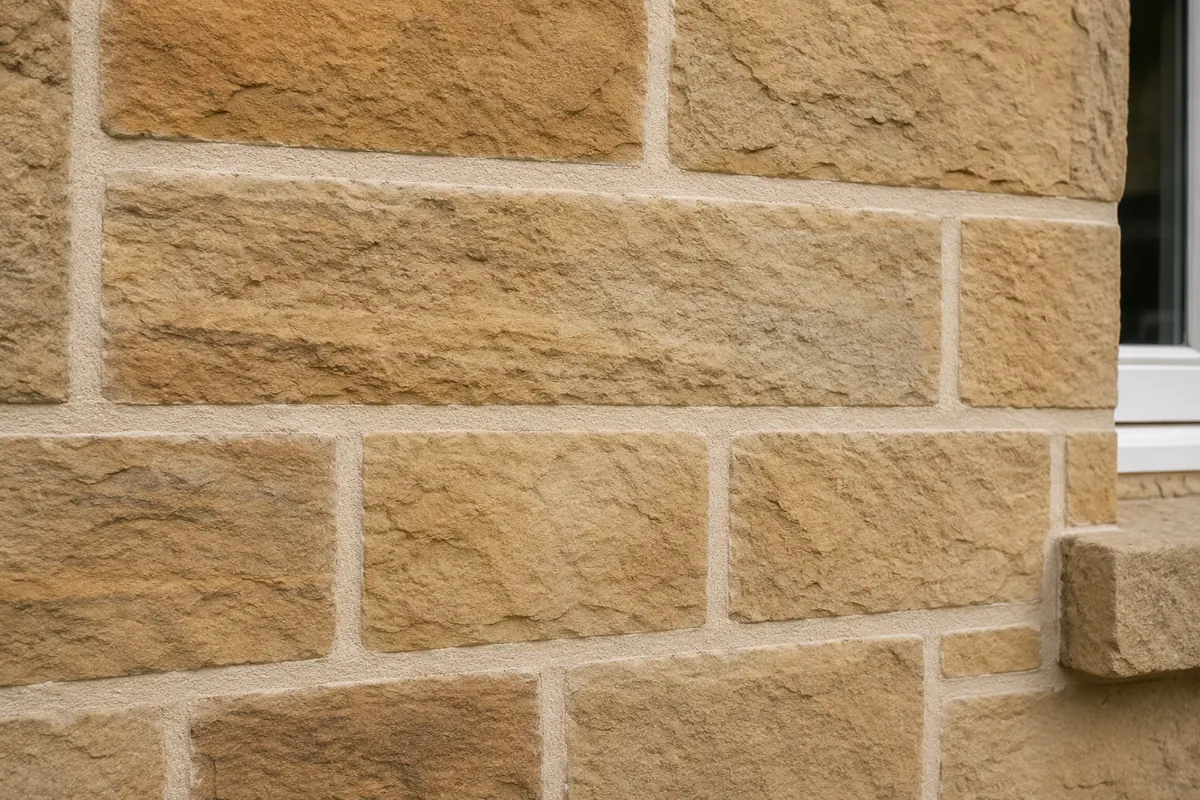
Repointing rakes out the old mortar and replaces it with a fresh lime mortar matched to the wall. It is the most common — and most protective — sandstone repair, because the joint is designed to be the soft, sacrificial part of the wall. When done in the right lime, it lets the wall breathe and stops the "erosion effect" caused by hard cement pointing. It is also the least invasive option: no original stone is removed.
Watch out for: joints raked out too shallow, or the wrong NHL grade — both shorten the life of the repair.
Stone repair & indent ("Dutchman")
Best for: a single block or a defined area that has decayed, while the surrounding stone is fine.
An indent (sometimes called a "Dutchman") cuts out just the damaged portion of a stone and lets in a matching new piece, bedded in lime. It is the conservation-minded middle path: it keeps the maximum amount of original fabric, costs less than replacing the whole block, and — done well — is almost invisible. This is often the right answer for localised spalling caused by trapped salts or old cement repairs.
Watch out for: a poor stone match. The new piece must match the parent stone in type, colour and bedding direction, or it will weather differently and stand out.
Full stone replacement
Best for: a stone that has broken down structurally, lost its face entirely, or decayed too far to repair.
Here the whole block is cut out and replaced with a new, matched sandstone, bedded and pointed in lime. It is the most involved and most expensive of the unit repairs, so it is reserved for stones that are genuinely beyond saving. The skill lies in sourcing and matching the replacement stone — ideally from a quarry producing stone of the same geology as the original.
Watch out for: using a harder or denser replacement stone than the original, which can damage neighbouring blocks over time.
Lime harling & render
Best for: walls that were originally rendered or harled and have lost that protective coat — common on exposed Scottish elevations.
Harling is the traditional Scottish roughcast: a lime render thrown onto the wall to give a breathable, weather-shedding coat. Many buildings were never meant to have bare stone exposed — the harling was the sacrificial weather layer. Re-harling in lime restores that protection while keeping the wall breathable. It is often the most cost-effective way to weatherproof a large, exposed elevation.
Watch out for: cement render, which looks similar but traps moisture and cracks — recreating the very damage it was meant to prevent.
Lime (plastic) repair
Best for: minor surface loss, eroded edges, or small areas of decay too shallow to justify an indent.
Also called mortar repair, this rebuilds small losses with a colour- and texture-matched lime mortar, shaped to the original profile. It is the lightest-touch repair for cosmetic or minor damage and can extend the life of a stone considerably. It is not a substitute for replacing a structurally failed block — but for small, superficial losses it is ideal.
Watch out for: over-use. Large plastic repairs can fail or look artificial; beyond a certain size, an indent is the better answer.
Cost orientation (guide figures)
Every wall is different, so these are orientation figures only, drawn from published 2026 UK rates. The real cost depends on the stone, the condition, access and scaffolding — and is only firm after an on-site assessment.
| Method | Guide figure (2026) | Notes |
|---|---|---|
| Lime repointing (stone) | ~£70–90 / m² | Higher than brick due to irregular joints; raking out old cement often adds £20–50/m². |
| Stone repair / indent | Per stone — on assessment | Depends heavily on size, access and stone match; quoted per unit after survey. |
| Full stone replacement | From ~£15–30+ per stone, up | Wide range; large or carved stones and sourcing a match increase cost significantly. |
| Lime harling / render | On assessment | Priced by area and number of coats; often cost-effective for large exposed walls. |
| Lime (plastic) repair | On assessment | Small, localised work; usually priced within a wider repair schedule. |
| Scaffolding (typical house) | ~£500–1,500 | A separate line on most quotes; ground-level or single-elevation work reduces it. |
These are starting-point ranges to help you budget, not a quote. On a historic building the condition of the stone and the access are what really move the price — which is why a firm figure only follows an on-site assessment and, where needed, a moisture and mortar analysis.